This also applies to cable, chain, and webbing.
Gear that is anchored includes anchors, rocks, trees, tripods, trucks, etc.
A "bight" is a simple loop in a rope that does not cross itself.
A "bend" is a knot that joins two ropes together. Bends can only be attached to the end of a rope.
A "hitch" is a type of knot that must be tied around another object.
"Descending devices" (e.g., ATCs, Brake Bar Racks, Figure 8s, Rescue 8s, etc) create friction as their primary purpose. The friction in descending devices is always considered when calculating forces.
The "Safety Factor" is the ratio between the gear's breaking strength and the maximum load applied to the gear (e.g., 5:1).
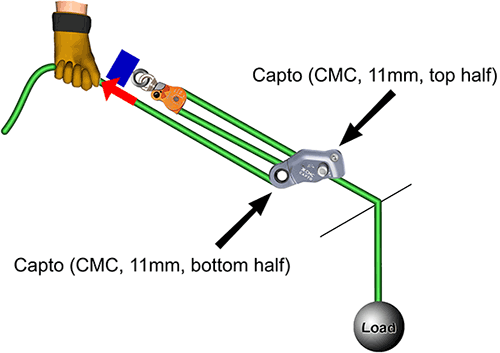
The CMC Capto combines a rope "grab" and a pulley. This creates complications for vRigger that can prevent the ropes from connecting to the Capto correctly. Our solution was to create two versions of the Capto.
The one piece Capto, shown here, is useful when you want to create an image and don't need to calculate forces. A sample file provides additional instructions on using this Capto.
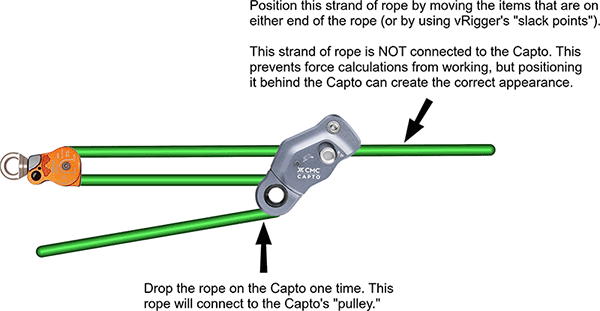
There is also a two-piece Capto in vRigger that is supplied with a "top" and "bottom" half. You can connect ropes to each of these halves and then connect the two halves as shown here. This will usually allow you to calculate forces.